“We were throwing away a resource on one end, and extracting more on the other,” Thao explains, noting that Viet Nam generates more than 100 million tonnes of agricultural by-products each year. That realization became the starting point for a business model that turns low-value residue into durable export-grade logistics materials.
NetZero Pallet collects agricultural by-products from cooperatives and waste collectors, processes them into engineered composite materials and manufactures pallets that meet global logistics and food safety standards.
“Every six pallets manufactured by NetZero Pallet saves one 20-year-old pine tree or nine Vietnamese acacia trees,” says Thao, adding that each pallet avoids around 30 kg of carbon dioxide emissions. By repurposing residue that might otherwise be burned, the model also supports improved air quality and new income streams for rural communities.
Since 2023, the company has upcycled thousands of tonnes of agricultural and industrial residue into pallets, benefiting more than 3,000 farming households through supplementary income from supplying by-products. Women who frequently participate in collection and pre-processing are now connected to a value chain that links local agriculture to regional and global markets. In fact, the company’s facility in Binh Duong Province has an annual production capacity of up to 1.5 million pallets.
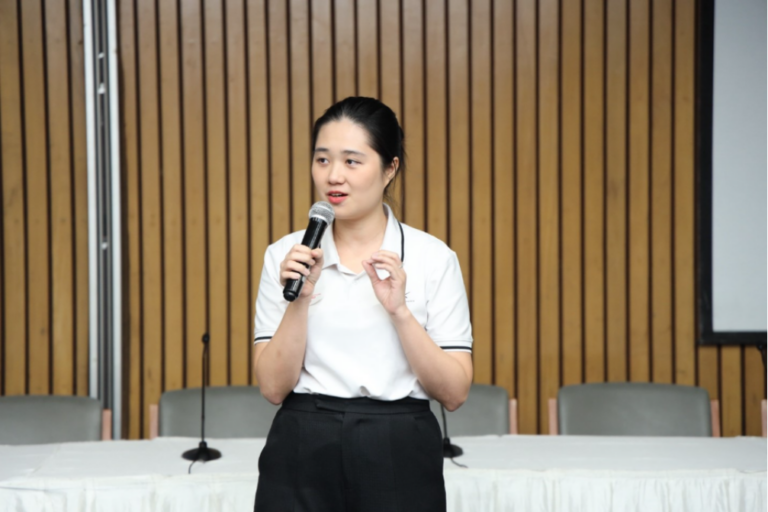
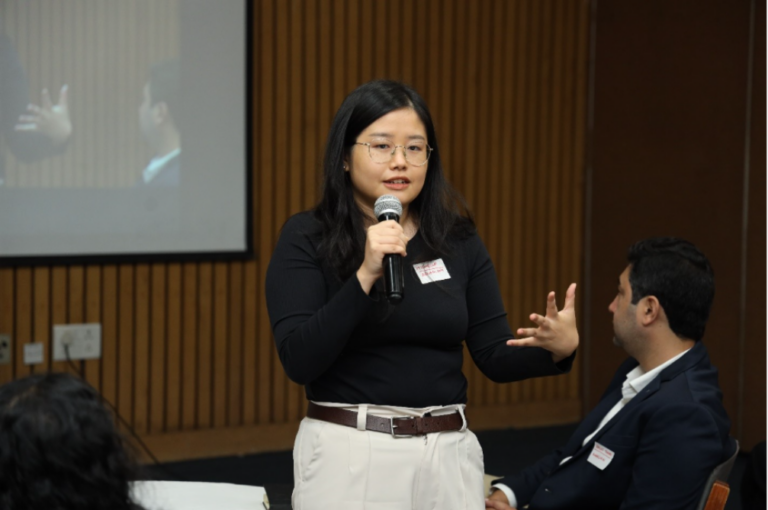
Thao Tran at an event showcasing her company and products. Photo: Courtesy of NetZero Pallet.
Building a climate-tech manufacturing business has not been easy. “As a woman founder in an industrial setting, I had to continually prove myself and the product,” Thao says, adding that she has turned these challenges into a strength.
“In technical and operational discussions, what matters most is clarity, data, standards and results,” she says. “I lead with logic and evidence, and I’ve found that partners respect that.”
This approach has fostered a company culture where credibility is earned through execution rather than titles.
Her participation in the UN Women Care and Climate Entrepreneurship Accelerator, supported by Visa Foundation with contributions from the CHARLES & KEITH Group Foundation, helped strengthen NetZero Pallet’s growth strategy and impact measurement. Through the programme, the company refined its expansion plans, deepened customer partnerships and began formalizing tracking systems.
“I am now building an impact system baselines, metrics and evidence that we can improve over time across climate, social and gender outcomes,” Thao reflects.
According to Niharika Agarwal, Principal at Intellecap, which is advising NetZero Pallet as part of the Entrepreneurship Accelerator: “NetZero Pallet’s model demonstrates how circular use of residues can translate into a scalable, commercially viable pathway for industrial decarbonization. The company shows strong potential to reduce emissions at scale by converting agricultural waste into a high-performance, sustainable logistics product.”
Janelle Weissman, Head of External Relations at the UN Women Regional Office for Asia and the Pacific, adds: “Partnerships are critical to ensuring women-led climate solutions can move from pilot to scale, and this Accelerator is one example of UN Women connecting women entrepreneurs with the financing, networks and technical support they need to grow businesses that deliver climate and equality outcomes.”
NetZero Pallet demonstrates how investing in women-led climate enterprises can deliver measurable results – reducing emissions, creating livelihoods and advancing more circular, resilient economies.
Looking ahead, NetZero Pallet plans to expand through regional partnerships and replicate its manufacturing model closer to agricultural waste sources.
“Farmers were expected to absorb climate risk, price volatility and ecological degradation, while solutions were designed far from their lived realities,” she explains. “Inputs were extractive, advice was generic and success was measured in short-term yield rather than long-term resilience.”
Michelle began looking for a practical solution farmers could afford and use easily, even as climate pressures grew. That search led her to the ocean, which was all around her in Indonesia.
Her start-up AquaBloom set out to produce biostimulants made from seaweed that help plants grow stronger and better withstand climate stress.
Seaweed grows naturally without freshwater, fertilizer or farmland, making it a sustainable resource. When processed correctly, seaweed enhances nutrient uptake, root development and stress tolerance in crops, allowing farmers to use less chemical fertilizer. Because it works with existing crops and farming practices, farmers don’t need to buy new equipment or change what they grow.
The model also connects two groups that rarely interact: coastal seaweed producers and land-based farmers. Farmers gain a tool to improve yields and resilience, while seaweed producers gain more stable and higher-value markets for their harvests.
To date, AquaBloom has tested its products across 27 crops, delivering 20–30 per cent yield improvements and more than a 10-times return on investment for farmers within a single growing cycle. With these results, Michelle is now preparing to scale the solution for wider commercial use.
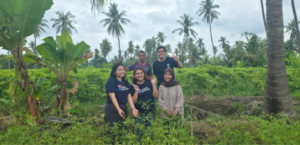
Michelle with her team at a farm in Indonesia where trials were conducted. Photo: Courtesy of AquaBloom.
However, building a hard-tech company came with its own unique hurdles. In the early days, acquiring technical knowledge meant spending time with farmers on the field. At the same time, as an entrepreneur, Michelle often attended late-night meetings with stakeholders.
As a young woman, Michelle also had to navigate cultural norms. For instance, being too engaged could be perceived as being “over-familiar.” And she says working through male intermediaries sometimes slowed her learning, added friction or introduced subtle biases. Once, she was advised to lower her speaking voice to sound more authoritative.
“This feedback was never about the substance of what I was saying, but about how my body and voice were read in the room,” she reflects, underscoring the invisible constraints women founders face in establishing credibility.
But Michelle says participating in the UN Women Care and Climate Entrepreneurship Accelerator, supported by Visa Foundation with contributions from the CHARLES & KEITH Group Foundation, helped her refine the company’s approach towards both business and gender.
“The programme challenged me to articulate the impact to align with unit economics,” she says. It also prompted the enterprise to shift towards designing systems that reflect how women engage with technology. AquaBloom refined its communication, creating clearer, application-focused instructions that lower the barrier to entry for women farmers who manage daily crop decisions. It also directly engaged women farmers and agronomists in trials.
Katja Freiwald, UN Women Asia and the Pacific Regional Lead for Women’s Economic Empowerment, says AquaBloom demonstrates the power of women-led solutions to strengthen livelihoods and climate resilience: “With the right partnerships and support, women entrepreneurs can scale solutions that improve food systems, incomes and climate adaptation.”
AquaBloom shows that the most effective climate solutions honour both the biological realities of the planet and the economic realities of its people. By turning seaweed into a tool for agricultural resilience, the company is proving that hard-tech innovation can be inclusive, regenerative and profitable.
According to Shraddha Kothari, Principal at Intellecap, which is advising AquaBloom through the Entrepreneurship Accelerator: “AquaBloom is positioned to unlock meaningful economic opportunities for women and other coastal producers. By transforming coastal biomass into high-value bio-stimulants, the enterprise demonstrates strong potential to drive scalable adoption of regenerative farming practices across the region.”